Words Matter
Words are everywhere in our digital products, yet many designers consider the text in their designs an after-thought.
Talk summary
Words matter in your user experience
Our choice of words can significantly influence the user’s experience of our products, positively or negatively. Finding the right text for your product can be a difficult process. The good news is you can craft effective text by following the design process you are used to.
UX writing treats words as products. By understanding your user’s needs, following evidence based usability guidelines and evaluating with user testing, you too can create writing that is both accessible and engaging.
Topics covered
- Prevalence of text in design
- Influence words have on users
- Incorporating UX writing into your workflow
- Learning resources
The event
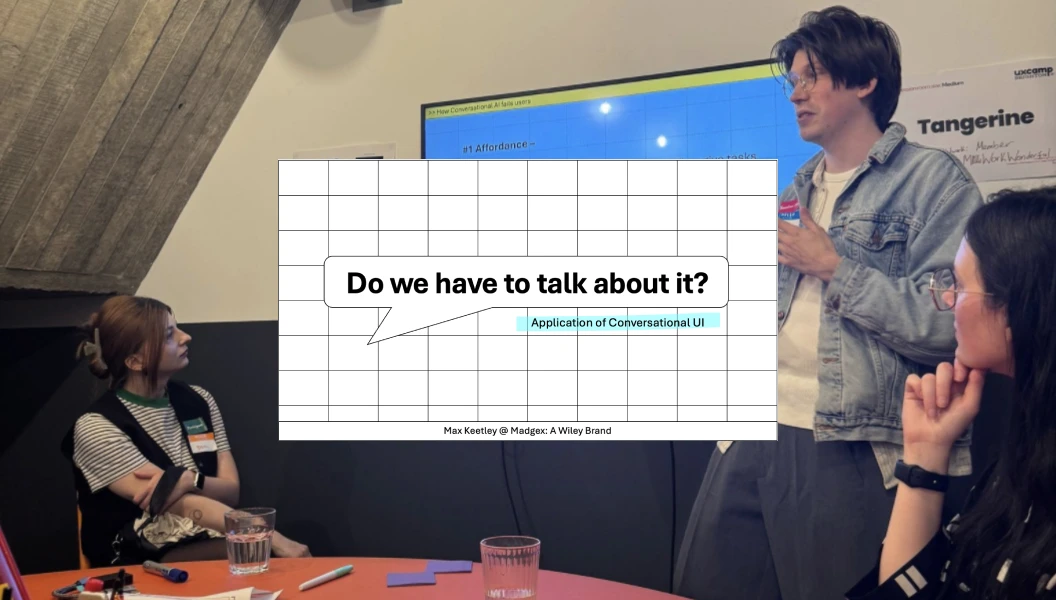
UX Camp Brighton Redux
The Redux is the second outing for the sessions that landed best at the main unconference, so the room already knew it wanted this one. In the organisers’ words:
Each year we hold the UX Camp Brighton Redux event, a few months after the main unconference. This gives everyone a second chance to see some of the highlights from the main event. We invite speakers based on feedback from attendees on which sessions they enjoyed the most. This year we’re hosting the event jointly with local meet-up group, UXup. In the style of their meet-ups, we’ll be adding a little extra sprinkle of interactivity to the 2023 Redux.

Talk materials
Learning resources
The three places I sent the room to afterwards, and still the fastest way into UX writing if you are starting from a design background.
UX Writing study guide
Nielsen Norman Group's collection of links to their articles and videos, covering how to write and present information that aligns with users' needs and online reading behaviours.
The UX Writing Library
Books, blogs, communities, online courses, events, podcasts and newsletters, gathered to give you a current and focused overview of the field and help you stay on top of the game.
Readability guidelines
Content Design London's collaboratively developed, universal content style guide, based on usability evidence rather than house preference.
My takeaways
My writing tools
What I took away from preparing this talk is a small set of instruments, not a theory. These are my custom tools that I regularly use in my UX writing process.
Download them and give them a try for yourself. Like UX design, there is no official process to UX writing, pick and customise the variety of tools that work best for you.
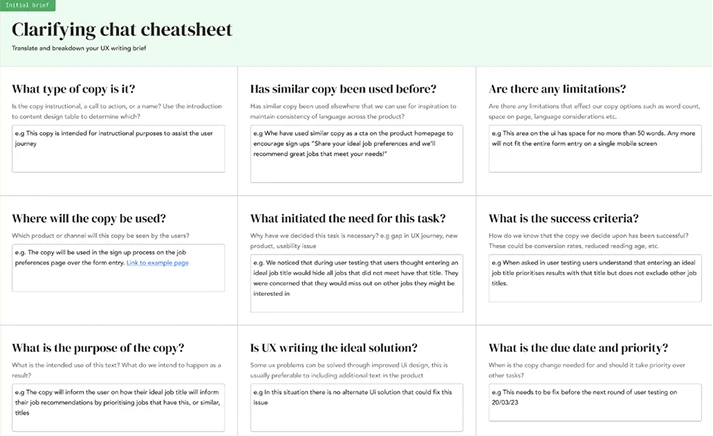
Clarifying chat cheat sheet
Like any piece of design work it is important to understand your brief. Before you begin, complete this cheatsheet to understand the boundaries of your UX writing challenge.
Download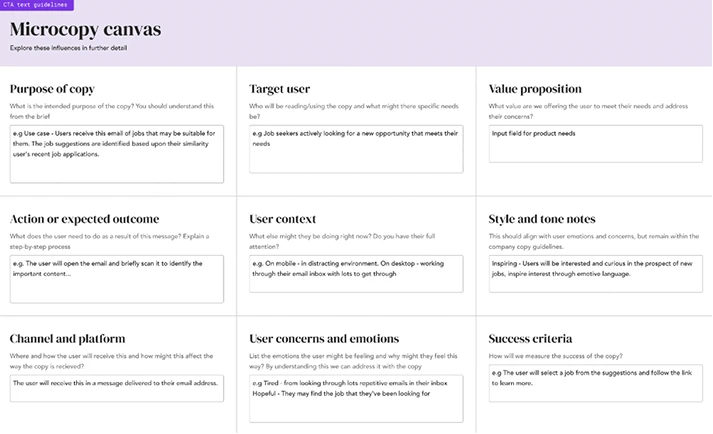
Microcopy canvas
Complete this canvas to help you consider all the key influences of your UX writing goal.
Download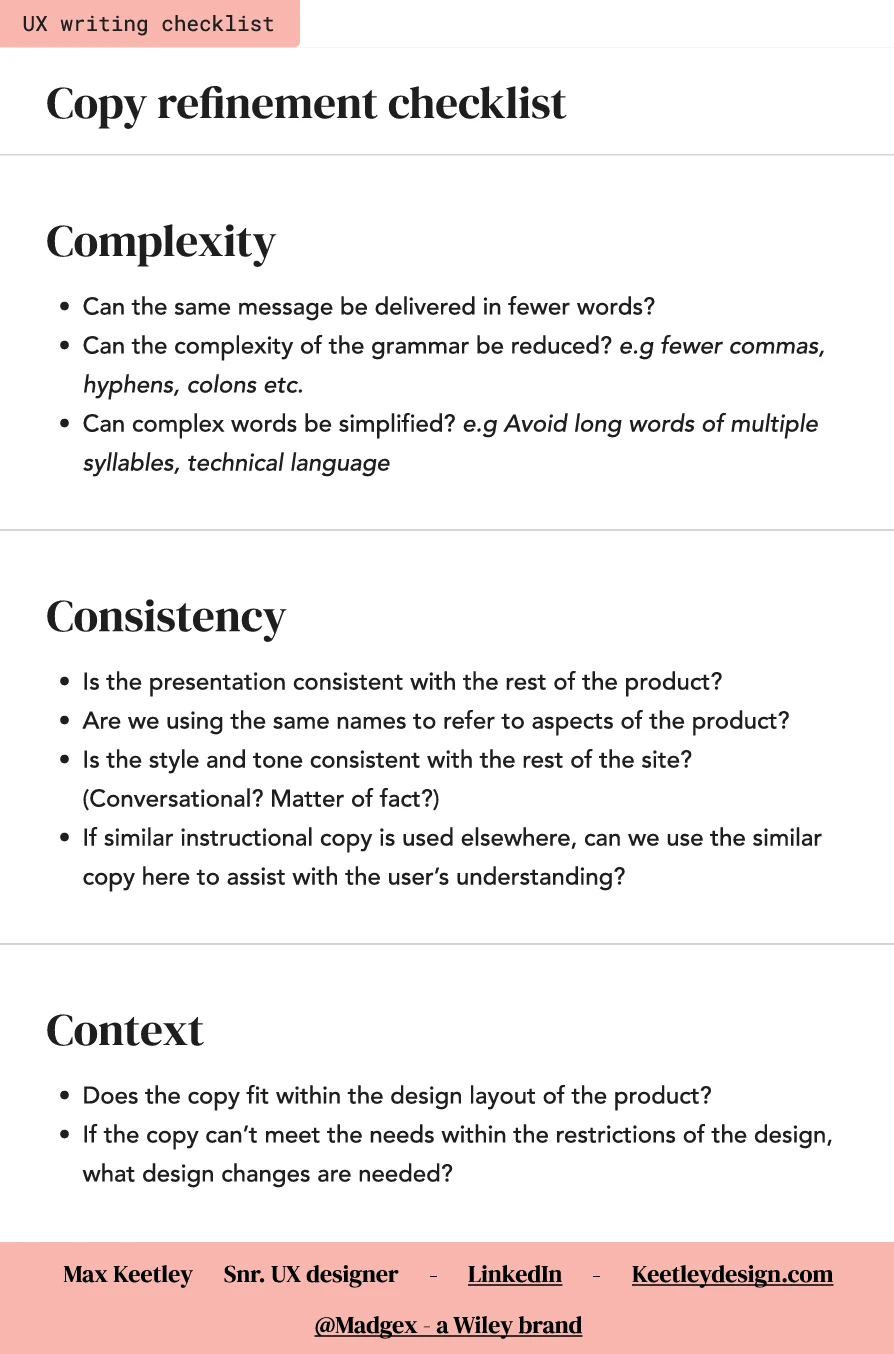
Copy refinement checklist
Review your UX writing with this handy checklist. A selection of questions cover the key guidelines for copywriting, each required to meet basic usability requirements.
Download