0 1 - Intro
Do we have to talk about it?
02 - The Premise
AI is everywhere, bringing conversational interfaces with it
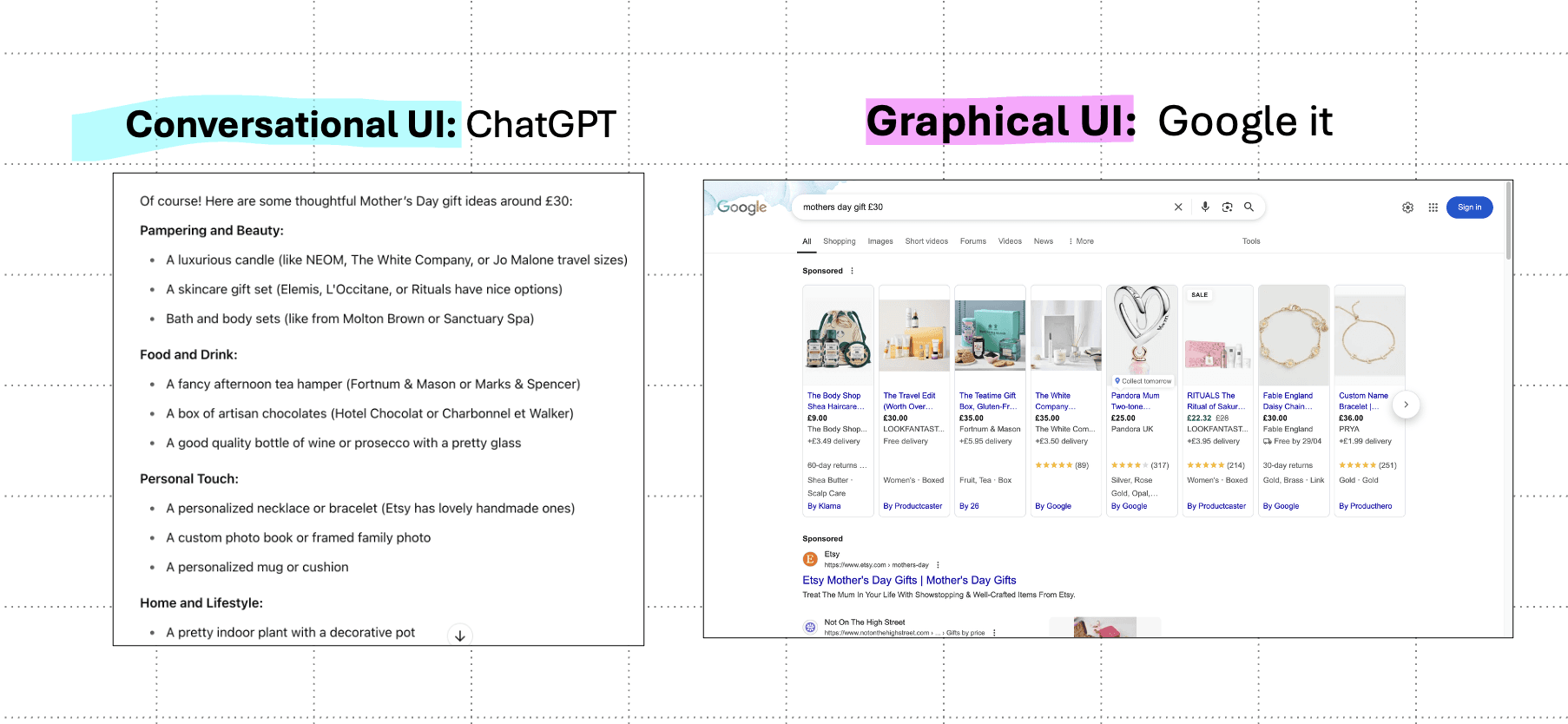
Big tech is spending a fortune to educate the mass market on how to engage with conversational interfaces. Leaving behind all that we have learned about traditional Graphical UI.
The core tension
Conversational interfaces put all of the agency on the user, asking them to think what they want whilst failing to show them what's possible. Should we be expecting users to articulate their own needs to use our product?
03 — The Framework
Graphical or Conversational? It depends on the task
The answer isn't "always conversational" or "always graphical." It depends on the nature of the task. Most products get this wrong by defaulting to chat when they should be guiding users through structure.
AMBIGUOUS, EXPLORATORY OR GENERATIVE TASK
Conversational UI is great, but…
Support the lack of affordance and hierarchy with graphical in-chat elements.
Reduce cognitive load with suggestions and persistent visual documents.
When creating content, use an iterative canvas to improve consistency and navigation.
STRUCTURED, REPETITIVE OR HIGH-STAKES TASK
Think Graphical UI first
Create a UI that guides the user through a process and sets clear expectations.
Use forms to help users craft prompts.
Use buttons and lists of actions to perform repeatable AI tasks.
Consider intelligent UI elements that adapt to each user with predictive AI.
08 — The Takeaway
How could you build better AI tools, that support and guide users?
The question isn't whether to use AI. It's whether conversation is the right interface for the job. The best AI products don't ask users to articulate everything, they show what's possible and let users refine from there.
Remember… "Do we have to talk about it?"